
















Latest Update
Live Stream from ABC News 4 (when on air)
Must enable Flash Player to load Live Stream from ABC News 4.
Hurricane Dorian: What to Expect in Charleston & the Lowcountry
Wednesday, September 4th 2019 - from ABC News 4 - See Original Article
The center of Hurricane Dorian will pass by the coast of South Carolina Wednesday night through Thursday, putting the Lowcountry and other areas in the path of dangerous, destructive weather.
Dorian, a category 2 hurricane, will bring damaging hurricane-force and tropical storm force winds, torrential rain of 5-10 inches or more, flash flooding, tidal flooding, river flooding, possible storm surge and other effects to Charleston and surrounding areas inland and along the coast.
Dorian was about 235 miles south of Charleston as of 8 a.m. Wednesday, moving north-northwest at 8 mph. The storm had sustained hurricane-force winds at its center of 105 mph, with tropical storm-force winds extending outward 175 miles.
The first bands of rainstorms associated with Hurricane Dorian began coming ashore along the South Carolina coast after sunrise Wednesday morning.
As the storm continues progressing, here are the effects the coastal and inland areas of South Carolina can expect.
COASTAL IMPACTS
Coastal flooding appears to be one of the most significant threats facing coastal areas, with extreme high tides forecast to coincide with Dorian's passing.
High tides are forecast of 9.3 feet Wednesday at 1 p.m. and 10.3 feet Thursday at 1 a.m., two and three feet above normal flood stage, respectively.
Much of the Charleston peninsula and surrounding low-lying areas that traditionally flood during high tides and heavy rains will be at risk of even greater flooding during Dorian.
Meanwhile, both hurricane and storm surge warnings are in effect for all or portions of every county along the South Carolina coast.
That means sustained winds of 74 mph or greater and flooding from ocean water blown inland are likely at times over the next 36 hours, in addition to torrential rainfall and widespread flooding.
All of Beaufort, Berkeley, Charleston, Georgetown and Jasper are under the hurricane warning, along with coastal portions of Colleton County.
All of Beaufort, Charleston and Georgetown counties are under the storm surge warning, along with coastal portions of Berkeley, Colleton and Jasper.
According to ABC News 4's Storm Tracker team of Meteorologists, Charleston County and Georgetown County are most likely in the Lowcountry to see any significant hurricane-force wind impacts.
Hurricane-force winds extend about 60 miles from the center of Hurricane Dorian, and the eye is projected to pass about 20-50 miles off the coast near Charleston and Georgetown, Chief Meteorologist Dave Williams says.
These are the threats to expect from hurricane-force winds:
- Damage to sturdy buildings, including roofs, windows, doors, and garage doors. Some may fail, leading to structural damage.
- Mobile homes severely damaged, with some destroyed.
- Danger of death or injury from falling objects and airborne projectiles outside.
- Large trees snapped or uprooted.
- Roads and bridges impassable from large debris and damage.
- Widespread power and communications outages lasting for days.
Storm surge impacts look to be less likely, as that phenomenon is typically associated with the northeastern quadrant of hurricanes that make landfall, meaning their eyes come ashore.
While Dorian's eye is expected to make a close pass to the South Carolina coast, it is not forecast to make landfall. That will mean the majority of South Carolina's effects will be from the western, comparatively weaker side of the storm.
In that scenario, storm surge is not as great a risk, but 4-7 feet of inundation above sea level cannot be ruled out because of Dorian's strength and potential to move closer to shore than forecast at this time.
These are the threats presented if the Lowcountry does see storm surge:
- Large areas of deep saltwater inundation along shorelines and low-lying spots inland near rivers and creeks
- Structural damage to building, causing some to wash away or become uninhabitable.
- Sections of near-shore roads may be washed out or become flooded and impassable.
- Severe beach erosion with significant dune loss.
- Major damage to marinas, docks, boardwalks, and piers.
- Smaller boats breaking away from moorings and being set adrift, some carried inland and stranded.
- Drinking water and sewer services negatively impacted.
- Hazardous materials possibly present in surge water.
Specific Lowcountry communities at risk of these impacts from Hurricane Dorian include, Hilton Head, Bluffton, Beaufort, St. Helena, Lady's Island, Green Pond, Jacksonboro, Adams Run, Ravenel, Hollywood, Edisto Beach, Bennetts Point, Seabrook Island, Wadmalaw Island, Kiawah Island, James Island, Johns Island, Folly Beach, West Ashley, Charleston, North Charleston, Hanahan, Mount Pleasant, Sullivan's Island, Isle of Palms, Cainhoy, Awendaw, McClellanville, and Georgetown.
INLAND IMPACTS
Inland Colleton and all of Bamberg, Dorchester, Hampton, Orangeburg and Williamsburg counties are under a tropical storm warning.
That means dangerous and damaging sustained winds of 39-73 mph with higher gusts are likely at times over the next 36 hours, along with torrential rainfall and localized flooding.
Meteorologist Dave Williams says the entire Lowcountry from the I-95 corridor to the coast has a 70-90% chance of experiencing tropical storm-force sustained winds.
Threats from tropical storm-force winds include:
- Some damage to homes and buildings, such as roofing, siding, windows, doors, porches, awnings, carports, and sheds.
- Mobile homes damaged, especially if unanchored.
- Unsecured lightweight objects become dangerous projectiles.
- Large trees snapped or uprooted, some blocking roads.
- Fences and roadway signs blown over.
- Scattered power and communications outages due to damage.
Specific Lowcountry communities at risk of these impacts from Hurricane Dorian include Ridgeland, Yemassee, Hampton, Walterboro, Cottageville, St. George, Harleyville, Ridgeville, Holly Hill, Summerville, Goose Creek, Moncks Corner, St. Stephen, Jamestown, Bonneau and Andrews.
Track Hurricane Dorian
Wednesday, September 4th 2019 - from ABC News 4 - Go to Live Tracking
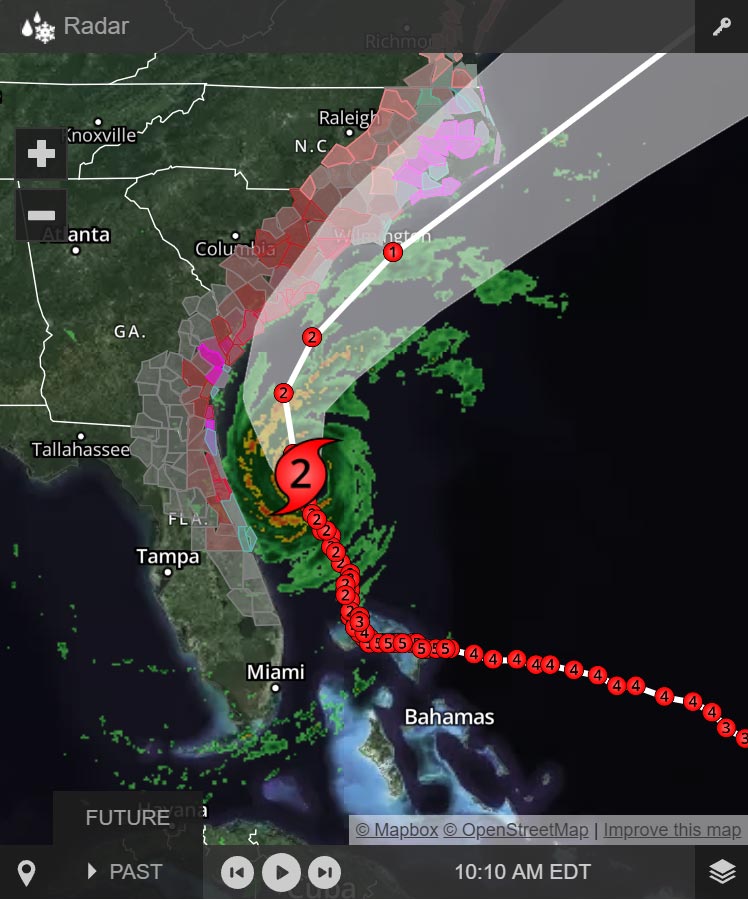
Cat. 2 Dorian slowly moving Tuesday night; Hurricane warning out for Lowcountry
Tuesday, September 3rd 2019 - from ABC News 4 - See Original Article
Dangerous and potentially life-threatening hurricane-force winds and storm surge are likely to impact portions of the South Carolina coast within the next 36 hours, as a weaker but expanding Hurricane Dorian moves north.
After an agonizing, destructive 18-hour stall over the Bahamas on Monday, Dorian began its long-predicted turn to the northwest on Tuesday morning.
Forecasters with the NHC say Dorian is building speed through Tuesday as it travels up the southeastern United States coast. The storm's western edge is forecast to skirt the coasts of Florida, Georgia, South Carolina and North Carolina through Friday.
The severity of the storm's impacts will depend on how close its core comes to land. While Dorian's powerful eye is not expected to make landfall, it is expected to come close.
Dorian will bring heavy rain, tropical storm-force winds, hurricane-force winds, flooding, storm surge and other impacts to various places along the coast.
South Carolina's coastal counties are expected to see those impacts beginning Wednesday and lasting through Thursday as the storm passes off our coast.
Tropical storm-force winds are likely as far inland as the Interstate 95 corridor, with hurricane-force winds of 74-110 mph likely along the immediate coast. Rainfall totals of 4-8 inches are most likely, with isolated higher totals possible.
Wind impacts including downed trees, structure damage and downed power lines are very likely, meaning power outages and street closures are likely during and after the storm.
Some flooding also likely will close streets and threaten low-lying properties in the event of heavy rainfall.
Storm surge is less likely given the eastern side of the storm is not forecast to pass over South Carolina, but it should not be ruled out. The National Weather Service says storm surge 4-7 feet above sea level in some areas is a possibility.