
Things to See in Charleston SC: The Complete Insider's Sightseeing Guide
Charleston is one of those cities that reveals itself in layers.The first time you visit, you see the postcard version: the pastel houses on Rainbow Row, the horse-drawn carriages on cobblestone streets, the church steeples rising above the rooftops. It is beautiful and it is real — do not let anyone tell you those things are not worth seeing.
This guide covers both worlds: the iconic sights you absolutely should not miss, and the local approach that will make you feel like you actually live here.
The Short Answer: The best things to see in Charleston SC start with the classics — Rainbow Row, the Battery, the historic graveyards, and the College of Charleston Cistern Yard — and then go deeper into the architecture, the hidden alleys, the museums, and the barrier islands. Spend your first day on the peninsula learning the city's bones. Spend your second day on the water or the beach. By day three, you will understand why people move here and never leave.
Quick Summary
|
The Sight |
Why You Must See It |
|---|---|
|
Rainbow Row |
13 pastel Georgian row houses on East Bay Street — the most photographed block in South Carolina |
|
The Battery & White Point Garden |
The southern tip of the peninsula, with cannon and Civil War monuments, harbor views, and antebellum mansions |
|
The Charleston Single House |
Understand why every house is one room wide and turned sideways to the street to catch the ocean breeze |
|
Earthquake Bolts |
The black iron circles on brick buildings — iron rods that held the city together after the 1886 earthquake |
|
Cobblestone Streets (Chalmers St.) |
River rocks used as ship ballast in the 18th century, dumped here when ships loaded up on cotton and rice |
|
The Cistern Yard |
Heart of the College of Charleston campus and the site of movies and where Obama's first presidential campaign announcement |
|
Gullah Geechee Tours |
The only full-blooded Gullah Geechee historian in the city tells the story no one else can |
|
Shem Creek at Sunset |
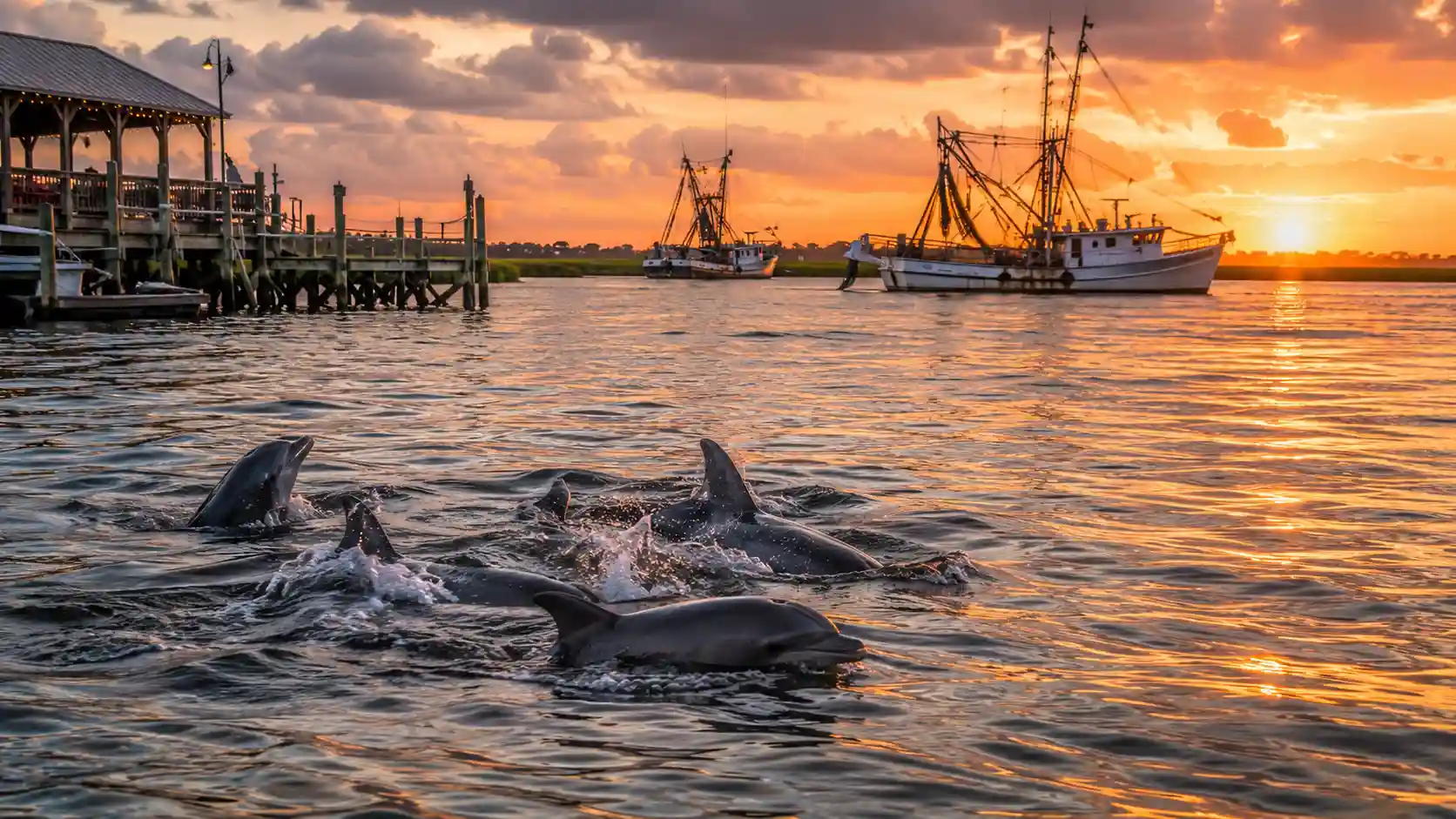
Dolphins, shrimp boats, and the best golden-hour views in the Lowcountry |
Table of Contents
- The Must-Dos: The Classics Are Classic for a Reason
- Read the Streets: Architecture, Alleys, and Hidden History
- The Museums Worth Your Time
- Eat and Drink Like a Local
- Island Day: Sullivan's Island, Folly Beach, or Isle of Palms
- See the City from the Water
- Frequently Asked Questions
The Must-Dos: The Classics Are Classic for a Reason
Before we get to the hidden gems, let us be clear: the iconic sights are iconic for a reason. Do not skip them out of some misguided attempt to avoid being a tourist. You are a tourist. Own it. See the things that made this city famous, and then go deeper.
Rainbow Row
The 13 pastel-painted Georgian row houses stretching along East Bay Street between Elliot and Tradd are the most photographed block in South Carolina. They are genuinely beautiful, and the story behind the colors is worth knowing: the buildings were painted in Caribbean-inspired pastels in the 1930s and 1940s during a restoration effort, a nod to the island influences that shaped the city's architecture. The best time to photograph Rainbow Row is early morning, before the tour groups arrive, when the light is golden and the street is quiet.
The Battery and White Point Garden
Walk to the very southern tip of the peninsula — where the Ashley and Cooper Rivers meet the harbor — and you are standing at one of the most historically charged spots in America. The Battery is lined with antebellum mansions, ancient live oaks draped in Spanish moss, and Civil War-era cannons pointed toward Fort Sumter. It was from this spot that Charleston residents watched the opening bombardment of the Civil War in April 1861. On a clear day, you can see Fort Sumter sitting in the middle of the harbor, small and distant, where it all began.
The Historic Graveyards
Charleston buries its dead in the middle of the city, and the graveyards are among the most atmospheric and historically significant places you can visit. St. Philip's Episcopal Church on Church Street has two graveyards — one on each side of the church — with headstones dating to the 1600s. Vice President John C. Calhoun is buried here. The Circular Congregational Church graveyard on Meeting Street is one of the oldest in the city, with table-top tombs that locals call "bedsteads." Magnolia Cemetery in North Charleston is a sprawling Victorian cemetery on the banks of the Cooper River, where Confederate generals, governors, and the crew of the H.L. Hunley submarine are buried. It is open to the public and genuinely stunning.
South of Broad
The neighborhood south of Broad Street is where the old money lives and has always lived. The streets here — Tradd, Legare, King, Church — are lined with some of the finest antebellum architecture in the country. Walk slowly. Look up at the piazzas. Peer through the iron gates into the walled gardens. Notice the scale of the houses and imagine the wealth — built on enslaved labor — that constructed them. This is the most beautiful and most complicated neighborhood in Charleston.
Insider Tip: The best street in Charleston for architecture is Legare Street (pronounced "Luh-GREE" — locals will know you are new if you say it wrong). Walk the full length of it from Broad Street south toward the Battery and you will pass some of the most extraordinary private homes in the country.
Read the Streets: Architecture, Alleys, and Hidden History
Once you have done the classics, it is time to start reading the city. Charleston's streets, buildings, and hidden passages are full of stories that most visitors walk right past.
The Charleston Single House
As you stroll through the historic district, you will notice that nearly every house seems to be turned sideways. This is the Charleston Single House — a unique architectural form that is only one room wide, with the narrow gable end facing the street. The long side of the house runs perpendicular to the street, and a multi-story covered porch called a piazza runs the full length of the south or west side.
This was not a stylistic choice. It was an engineering solution to the brutal Lowcountry heat. The piazza shades the windows from direct sun and catches the prevailing ocean breezes, funneling them through the house. The door you see from the street does not lead into the house — it leads onto the piazza. The actual front door is halfway down the porch. This confused visitors for 300 years and still confuses them today.
Earthquake Bolts
Look closely at the brick buildings throughout the historic district and you will see black iron plates on the exterior walls — often shaped like circles, stars, or S-curves. These are the anchor plates for earthquake bolts. Following the devastating 7.3 magnitude earthquake of August 31, 1886 — the most powerful earthquake ever recorded in the eastern United States — iron rods were driven entirely through the damaged masonry buildings and bolted on the outside to pull the walls back together. The city was rebuilt around its own skeleton. You are walking through the evidence.
The Cobblestone Streets
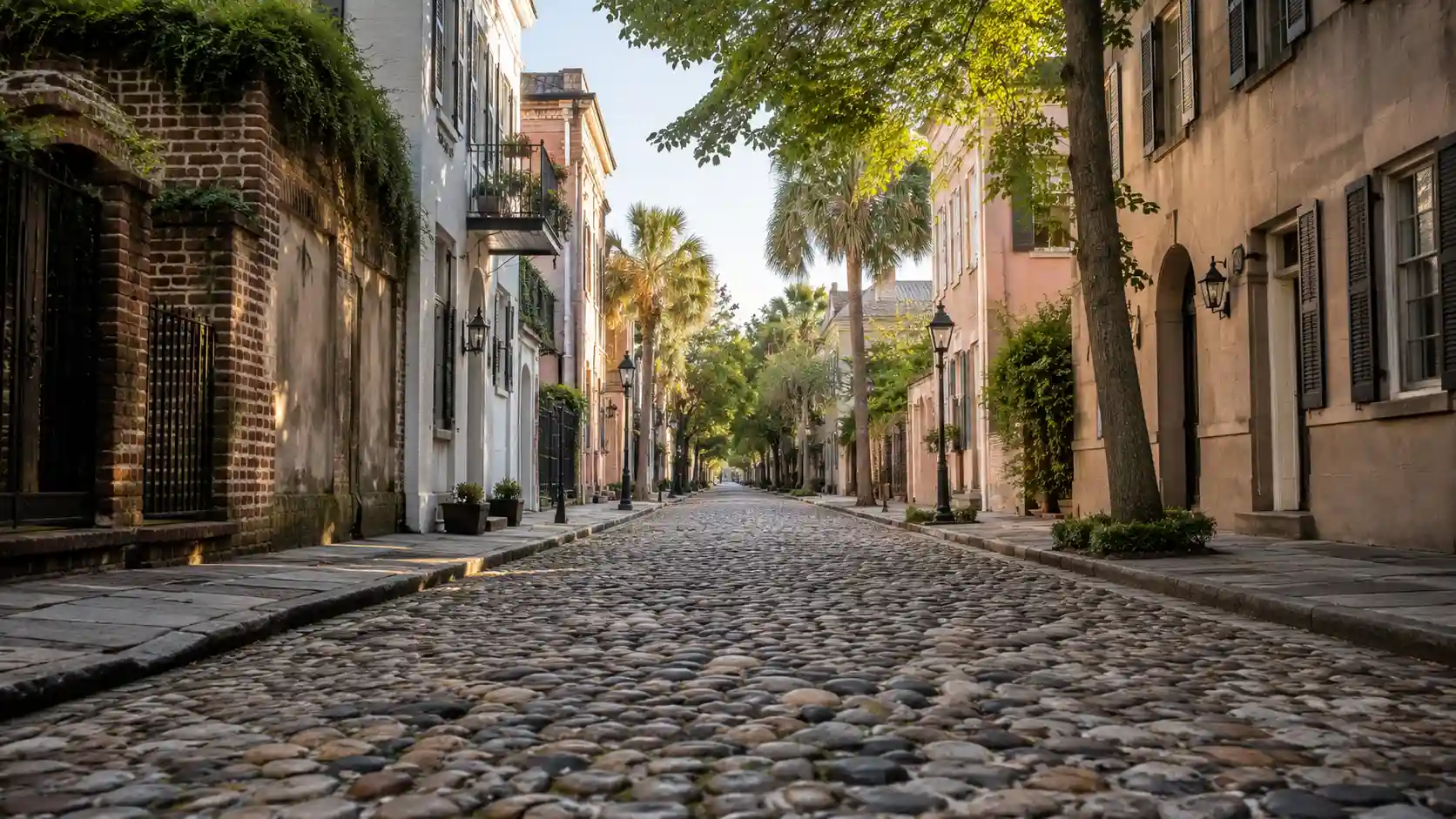
Chalmers Street is one of the few remaining cobblestone streets in the city, and the stones under your feet have a remarkable origin story. They are smooth, round river rocks — not the cut stone you see in European cities. They arrived in Charleston as ballast weight in the hulls of 18th-century English sailing ships. When the ships arrived in port, they dumped the ballast rocks to make room for cotton, rice, and indigo. The city used the discarded stones to pave the muddy streets. Every cobblestone on Chalmers Street came from the bottom of an English river and crossed the Atlantic in a sailing ship.
The Hidden Alleys
Charleston's most atmospheric spaces are not on the main streets. They are in the narrow passages between them.
Philadelphia Alley (also called Dueler's Alley) runs behind St. Philip's Church between Cumberland and Queen Streets. This shaded, brick-paved passage was the site of numerous deadly duels in the 18th and 19th centuries. It is quiet, slightly eerie, and completely off the tourist radar.
Longitude Lane runs between East Bay Street and Church Street and is one of the oldest lanes in the city. Stoll's Alley connects Church Street to East Bay and is so narrow that two people can barely pass each other. These alleys were originally service passages for the houses that fronted the main streets, used by enslaved workers and tradespeople.
The College of Charleston Cistern Yard
Walk through the gates of the College of Charleston on St. George Street and you enter the Cistern Yard — a broad, brick-paved green framed by ancient live oaks and the elegant Randolph Hall. This is one of the most beautiful college campuses in America, and it has been the setting for significant moments in history. In 2007, Barack Obama stood at a lectern in this yard and made one of his first major campaign appearances in the Democratic presidential primary. The yard has also served as a filming location for numerous movies and television productions.
The Museums Worth Your Time
Charleston has more museums per square mile than almost any city in the South, and several of them are genuinely world-class.
The Charleston Museum on Meeting Street is the oldest museum in America, founded in 1773. It covers the full sweep of Lowcountry history, natural history, and decorative arts. The International African American Museum (IAAM) on the waterfront is the newest and most important — it opened in 2023 on the site of Gadsden's Wharf, where more than 40% of all enslaved Africans brought to North America first arrived. It is a profound and essential experience. The Gibbes Museum of Art on Meeting Street houses an extraordinary collection of American art with a particular focus on Charleston and the South. On the First Friday of every month, the French Quarter galleries open their doors for the Art Walk — free wine, free admission, and a chance to browse the city's best private galleries.
Eat and Drink Like a Local
You cannot truly see Charleston without tasting it. The food here is not a side attraction — it is part of the culture.
Start your morning at Babas on Cannon (11 Cannon Street), a beloved European-style neighborhood café that serves exceptional coffee and house-made pastries. It has three locations downtown, but the Cannon Street original is the one locals love most. Buy a cup, pick a direction, and start walking.
For lunch or dinner, the true local spots are mostly off the peninsula. Bowens Island Restaurant is located at the end of a dirt road off Folly Road — an aging, graffiti-covered cinder block building that has been serving the best roasted oysters and fried shrimp in the Lowcountry since 1946. It won a James Beard Award. You go for the oysters, but you stay for the sunset views over the marsh.
On Sullivan's Island, Poe's Tavern on Middle Street serves the best burgers in the area in a pub covered wall-to-wall in Edgar Allan Poe memorabilia. Poe was actually stationed at Fort Moultrie on Sullivan's Island as an 18-year-old soldier in 1827, and he used the island as the setting for his famous story The Gold-Bug. After your burger, walk next door to Beardcat's Sweet Shop for house-made gelato and espresso.
Island Day: Sullivan's Island, Folly Beach, or Isle of Palms
Downtown Charleston is only half the story. To understand how locals actually live, you have to cross the bridges. Pick one island and make a full day of it.
Sullivan's Island: The Quiet, Literary Island
Sullivan's Island is a small, residential barrier island connected to Mount Pleasant by the Ben Sawyer Bridge. There are no chain restaurants, no high-rises, and no public parking lots — just street parking on Middle Street. Browse the handful of local shops, grab a burger at Poe's Tavern, and then head to the beach.
At low tide, walk south toward Breach Inlet — the narrow, churning channel that separates Sullivan's Island from Isle of Palms. Dolphins feed here constantly, using the strong tidal currents to trap fish. Watch from the shore (do not swim — the currents are genuinely dangerous), and look across the inlet toward the Isle of Palms. On the Sullivan's Island side, you can explore the tidal pools at low tide, play Spikeball on the wide, flat beach, or simply walk for miles in either direction without seeing a crowd.
Fort Moultrie, where Poe was stationed and where the Confederacy fired on Fort Sumter in 1861, is open to the public as a National Park site on the western end of the island.
Folly Beach: The Bohemian Surf Town
Folly Beach is everything Sullivan's Island is not: loud, colorful, slightly chaotic, and deeply beloved. This is where the surfers, the musicians, the artists, and the college students go. The Washout on the eastern end of the island is the best surf break in the area. The Folly Beach Pier is one of the longest fishing piers on the East Coast, and on select evenings in the summer, it hosts the Moonlight Mixers — outdoor dances where locals of all ages gather to shag (the official state dance of South Carolina) to live beach music over the Atlantic Ocean.
For dinner on Folly, Bowens Island Restaurant is just a few minutes away on Folly Road and is the perfect ending to a beach day.
Isle of Palms: The Windjammer and Volleyball
Isle of Palms is the most developed of the three islands, with a proper commercial strip and the famous Wild Dunes Resort. But the reason locals drive out here is The Windjammer — a legendary beachfront dive bar right on the sand at the end of Palm Boulevard. You can eat oysters at picnic tables, play beach volleyball on the courts out front, and watch live bands perform with the ocean as their backdrop. It is one of the great outdoor music venues in the South.
See the City from the Water
Charleston is a peninsula, and you have not truly seen it until you have viewed the skyline from the harbor.
Shem Creek in Mount Pleasant is the working heart of the local shrimping industry and the absolute best place in the city to watch dolphins. The dolphins follow the shrimp boats in every evening to feed on the scraps, and the boardwalk along the creek is lined with restaurants where you can watch the whole show over a cold beer. If the creek looks familiar, it is because it serves as the primary filming location for the Pogues' boat scenes in the Netflix hit Outer Banks — the show is filmed almost entirely in Charleston, not North Carolina.
For a more private experience, book a charter with Southern Wonder Yacht Charters. A private yacht takes you out past Fort Sumter, under the Ravenel Bridge, and along the Battery seawall — the same view that Charleston residents have had from the water for 350 years.
Insider Tip: The Pineapple Fountain at Waterfront Park is not just for looking at. On a hot day, wading and splashing in the fountain is completely legal, completely encouraged, and one of the most joyful things you can do in Charleston.
Conclusion
The best things to see in Charleston, SC, include more than its famous pastel homes and waterfront views. Rainbow Row, the Battery, historic graveyards, and cobblestone streets deserve a place on every first-time itinerary. However, the city becomes even more memorable when you notice its hidden alleys, unusual architecture, local museums, and stories written into its streets.
Take time to walk instead of rushing between attractions. Look for earthquake bolts on old buildings, explore the Charleston Single Houses, visit the Cistern Yard, and spend an afternoon on Sullivan’s Island, Folly Beach, or Isle of Palms. End your day near Shem Creek or Charleston Harbor, where the skyline, shrimp boats, and sunset reveal a different side of the Lowcountry.
Charleston rewards curious visitors. See the landmarks first, then explore beyond the postcard views. That balance of history, food, architecture, beaches, and local culture is what makes Charleston a place people want to experience again.
Frequently Asked Questions
What is the most iconic thing to see in Charleston SC?
Rainbow Row on East Bay Street is the most photographed sight in the city. The 13 pastel Georgian row houses are genuinely beautiful and best seen in the early morning light before the tour groups arrive.
What are the best streets to walk in Charleston SC?
For architecture and atmosphere: Legare Street, Tradd Street, Church Street, and Chalmers Street (cobblestones). For shopping and energy: King Street from Broad to Calhoun. For hidden history: Philadelphia Alley and Stoll's Alley.
What are the best museums in Charleston SC?
The International African American Museum (IAAM) is the most important and most moving. The Charleston Museum is the oldest in America. The Gibbes Museum of Art is the most beautiful. All three are within walking distance of each other on Meeting Street.
Where is the Netflix show Outer Banks actually filmed?
Almost entirely in Charleston, South Carolina. Key locations include Shem Creek in Mount Pleasant, the Old Village in Mount Pleasant, and various spots on James Island and Johns Island.
What is the best beach near Charleston SC?
It depends on your style. Sullivan's Island is quiet, residential, and uncrowded. Folly Beach is bohemian, lively, and has the best surf. Isle of Palms is the most developed with the most amenities. All three are within 30 minutes of downtown.